





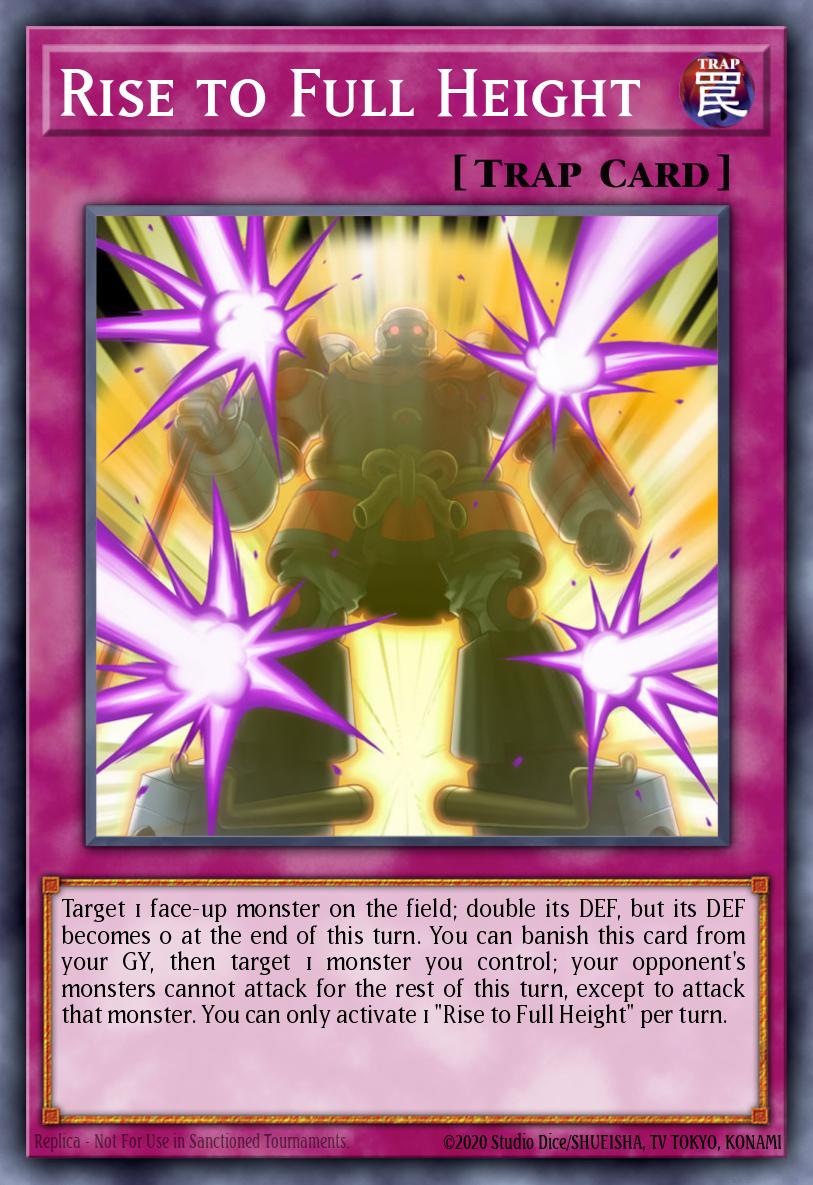

 Trap
 Normal
Rise to Full Height
View:
4171
Target 1 face-up monster on the field; double its DEF, but its DEF becomes 0 at the end of this turn. You can banish this card from your GY, then target 1 monster you control; your opponent's monsters cannot attack for the rest of this turn, except to attack that monster. You can only activate 1 "Rise to Full Height" per turn.
Rise to Full Height — Power Evaluation
Final Score: 64 ± 6 · Confidence: Medium
- Intrinsic: 62 · Deck: 65 · Meta: provisional
- Primary role: Removal / Negation · Secondary: Floodgate / Control, Utility
Why it scores here
Rise to Full Height is a control-oriented trap card that excels in disruption through its graveyard-activated second effect, which restricts opponent attacks to a single target for the turn. It is naturally accessible in hand or retrieved from the graveyard, and fits efficiently into diverse control shells without deckbuilding penalties. However, it generates no card advantage, does not participate in combo lines (no combo data supplied), and is vulnerable to trap negation, limiting its resilience and effectiveness in faster formats.
Axis scores
| Axis | Score | Evidence |
|---|---|---|
| Accessibility | 70 | Drawn naturally or activated from GY; no explicit searcher dependency; run at 2.28 copies average across 400 decks with 183 decks running 3 copies (verified). |
| Combo & Conversion | 35 | Does not build boards or enable combo lines independently; purely situational interaction; no combo data supplied to assess practical combo participation (inferred). |
| Resource Economy | 45 | One-card activation with no material return; pure tempo trade; neither card-negative nor card-positive; efficient for control shells accepting neutral exchanges (inferred). |
| Effect & Interaction | 65 | Strong attack-restriction effect via graveyard activation; minor DEF-buff on primary effect; synergizes with board-wipe partners (Divine Arsenal AA-ZEUS at 44.8%, Super Starslayer TY-PHON at 48.8%) in control shells (verified). |
| Material Utility | 0 | Trap card; cannot serve as summon material and contributes no level, attribute, or type synergy; zero utility outside trap activation (verified). |
| Resilience & Flexibility | 55 | Once-per-turn limit; vulnerable to trap negation via Infinite Impermanence, Solemn Judgment, or Solemn Strike; can activate from hand or GY for zone flexibility; lives across turns but fragile on turn of activation (inferred). |
| Deck-Building Efficiency | 75 | Splashable into 73 distinct archetypes with no deck locks or build restrictions; 3-copy staple with no garnet risk; efficient slot usage across control variants (verified). |
Calculation
Weight profile: Primary role: Removal / Negation. Intrinsic ≈ 62, Deck ≈ 65, Meta = provisional. Modifiers: none. Final formula: 0.40 * Intrinsic + 0.60 * Deck
Strengths
- Strong attack disruption through graveyard-activated second effect
- Splashable into 73 distinct archetypes without deck locks
- Efficient 3-copy staple with no garnet risk
- Redundant across zones (hand or GY activation)
- Natural synergy with board wipes and control finishers (ZEUS, TY-PHON partnerships)
Weaknesses
- Generates no card advantage or resource refuel
- Vulnerable to trap negation; fragile on activation turn
- Once-per-turn limit restricts multi-threat utility
- No combo line participation; does not build boards
- First effect (DEF doubling→reset) is niche and situational
Counters / choke points
- Infinite Impermanence
- Solemn Judgment
- Solemn Strike
- Any card that attacks the same turn the trap activates
Best use
Trap-based attack restriction and board stabilization. Decks: Paleozoic, Tearlaments Control, Lightsworn Control, Horus Control. Suggested copies: 3.
Evidence & gaps
- Verified: Card text clear: first effect doubles DEF with reset to 0 at end of turn; second effect banish-from-GY to restrict opponent attacks except to one target; Trap card; legal in TCG, OCG, MasterDuel; no banlist restrictions noted; Appears in 400 recent decks (Sept 2024–Sept 2026); average 2.28 copies per deck; Copy distribution: 1 copy (70 decks), 2 copies (147 decks), 3 copies (183 decks); Top partners include board wipes (ZEUS, TY-PHON), Link monsters (S:P Little Knight, I:P Masquerena), and Paleozoic archetype support; Splashable into 73 distinct archetypes; highest concentration in Paleozoic (28.6% combined across two entries)
- Observed: Primarily in control/midrange gameplay (62.5% of decks; gameplay type 7); Secondary presence in midrange builds (32.2%; gameplay type 4); Correlation with board-wipe cards and control staples suggests role as follow-up stabilization and tempo piece; High redundancy standard: 183 of 400 decks run 3 copies; only 70 run 1 copy; Paleozoic is dominant home; also strong in Tearlaments, Lightsworn, and Horus control variants
- Inferred: Primary role is attack negation and board control via restriction effect (not hard negate); Combo conversion is weak; does not generate tempo or resource advantage on its own; Material utility is zero (trap cards cannot serve as summon material); Accessibility is good; naturally drawn at high frequency (3-copy redundancy compensates for lack of searcher); Deck synergy is strongest in control shells running board wipes and negation layers; Resilience is moderate; once-per-turn clause and trap-line vulnerability (Impermanence, Judgment) limit multi-turn flexibility
- Data gaps: No combos supplied — combo conversion is text-only inference; cannot assess practical combo participation or board-building potential No banlist token — assumed 3-copy legal (unlimited) based on widespread 3-copy usage pattern Guide coverage limited to 1 Paleozoic guide; snippet does not detail card's specific role or interaction patterns Usage statistics available only for Guardragon (100% inclusion, 3 copies); most played homes (Paleozoic 28.6%, Tearlaments 11.8%) lack StatisticsCard coverage No top-card ranking — cannot confirm metagame tier or competitive prevalence First effect (DEF doubling→reset) has no direct evidence of utility; situational effect not detailed in guides or partner analysis